

“Once there was a young warrior. Her teacher told her that she had to do battle with fear. She didn’t want to do that. It seemed too aggressive; it was scary; it seemed unfriendly. But the teacher said she had to do it and gave her the instructions for the battle. The day arrived. The student warrior stood on one side, and fear stood on the other. The warrior was feeling very small, and fear was looking big and wrathful. They both had their weapons. The young warrior roused herself and went toward fear, prostrated three times, and asked, “May I have permission to go into battle with you?” Fear said, “Thank you for showing me so much respect that you ask permission.” Then the young warrior said, “How can I defeat you?” Fear replied, “My weapons are that I talk fast, and I get very close to your face. Then you get completely unnerved, and you do whatever I say. If you don’t do what I tell you, I have no power. You can listen to me, and you can have respect for me. You can even be convinced by me. But if you don’t do what I say, I have no power.” In that way, the student warrior learned how to defeat fear.” – An excerpt from the book, Things Fall Apart by Pema Chodron.
One of our greatest powers is learning how to befriend fear. When we feel it show up talking a mile a minute, it can sometimes feel like it takes over, controls us, and runs the show in terms of how we act next. But the trick to defeating fear is first learning how to develop some kind of respect and tolerance for the feeling of fear. We can simply notice the uncomfortable feeling of fear when it shows up in our body, and, instead of indulging in a dialogue with it, we can simply be a witness to it and label it when it arises, “Fear has shown up for me.” “I am feeling fear and it is uncomfortable.” This shifts the conversation we have with ourself, disrupting the chain reaction of the fearful voice taking over, building from 1 to 100 quickly, and controlling our next move. It puts us back into the driver’s seat to be with the fear without needing to react to it or have it control our actions, slowing us down and giving us the option of how we want to engage next. We can decide whether it is helpful to listen to its message and act accordingly or just notice that it is there and do nothing, remembering that if we don’t do what it tells us to do, it no longer has power.

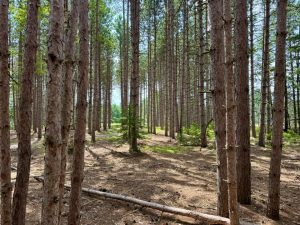 In 2020, when it felt like our sense of safety was already being threatened by all the instability that came with the covid-19 pandemic, I was eager to escape to the security of nature in my happy place. Only I was devastated to find that the wooded park path I knew, loved, and depended upon my entire life had been demolished. The beautiful, red pine trees that canopied the trail had all been chopped down, removing most of the beauty and magic that had provided so much calm and serenity.
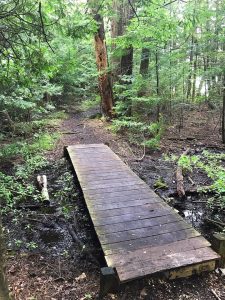 After riding for around five minutes, I reached the end of the demolished trees and the path veered back into woods again. Suddenly, I discovered a whole new hidden world that I had never known despite coming to this park all my life. Tall, magnificent pine trees shaded me from the harsh sun rays and then a meadow with beautiful wildflowers around the next bend.